ELMA: Benchmarking Anaphoric Compositions for Long-Term Text-to-Motion Generation
1 Keio University 2 Keio AI Center 3 Sony Group Corporation
Abstract
Text-guided long-term human motion generation is essential for applications such as continuously operating digital avatars. Despite recent progress on short clips, existing models struggle with multi-segment instructions that involve anaphora, where constraints established in earlier segments must be preserved over time. In this paper, we introduce a novel task of long-term motion generation from such anaphoric compositions. To address this gap, we present ELMA, an episodic long-term motion dataset with dense segment-level annotations that preserve cross-segment dependencies. Built via a fully automated collection and filtering pipeline, ELMA extracts high-quality, continuous 30-second clips from in-the-wild videos, capturing the episodic narratives necessary for long-range state modeling. Using ELMA, we benchmark representative long-term motion generation models under independent and anaphoric instruction settings, and study whether contextual fine-tuning improves long-range state modeling. Our extensive experiments provide insights into the capabilities and limitations of existing models in handling context-dependent instructions. These findings highlight the challenge of modeling cross-segment dependencies and offer valuable directions for developing more coherent and semantically consistent long-term motion generation models.
Dataset
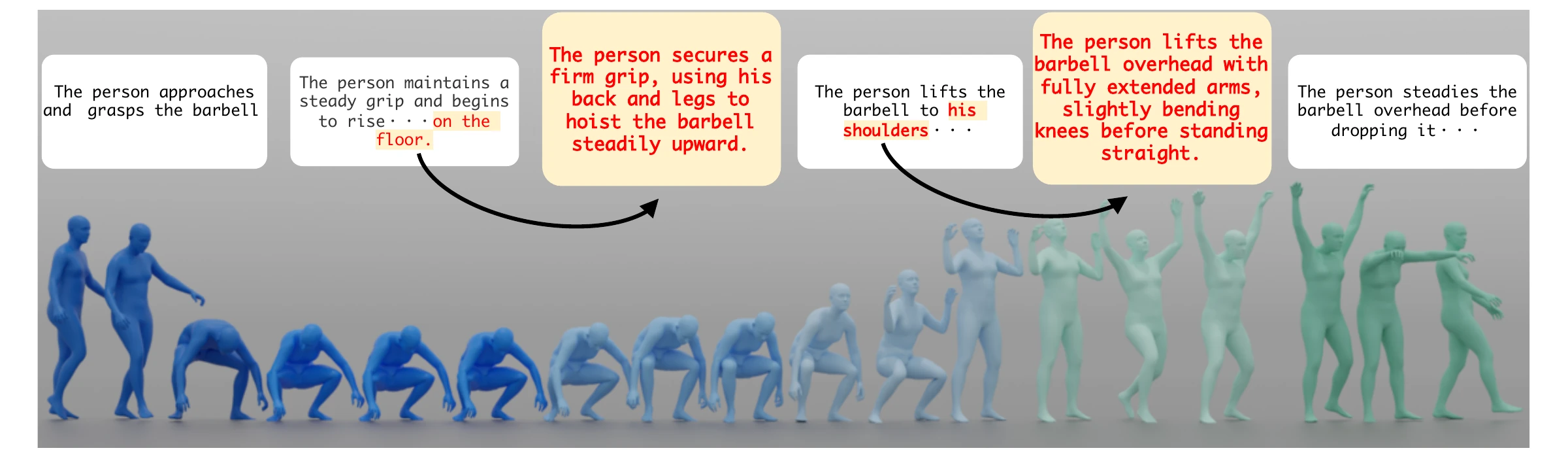
Dataset Examples
We introduce ELMA (Episodic Long-term Motion dataset with multi-segment Annotations), an episodic long-term 3D human motion dataset built from continuous 30-second clips with densely aligned segment-level captions that explicitly preserve and annotate anaphoric dependencies across segments. Unlike existing datasets that often lack temporal semantic coherence due to the aggregation of fragmented short clips or the synthesis of motion data using existing generative models, our approach leverages continuous in-the-wild RGB videos. We choose 30 seconds as a practical horizon that is long enough to exhibit cross-segment state persistence while remaining feasible for reliable tracking in unconstrained videos. By extracting uninterrupted 30-second sequences, ELMA naturally preserves the temporal semantic coherence and physical consistency of extended activities. These episodic clips provide the coherent context needed to capture long-range constraints, such as maintaining a hand pose while transitioning to locomotion or sustaining an object-holding state across segments.
Pipeline
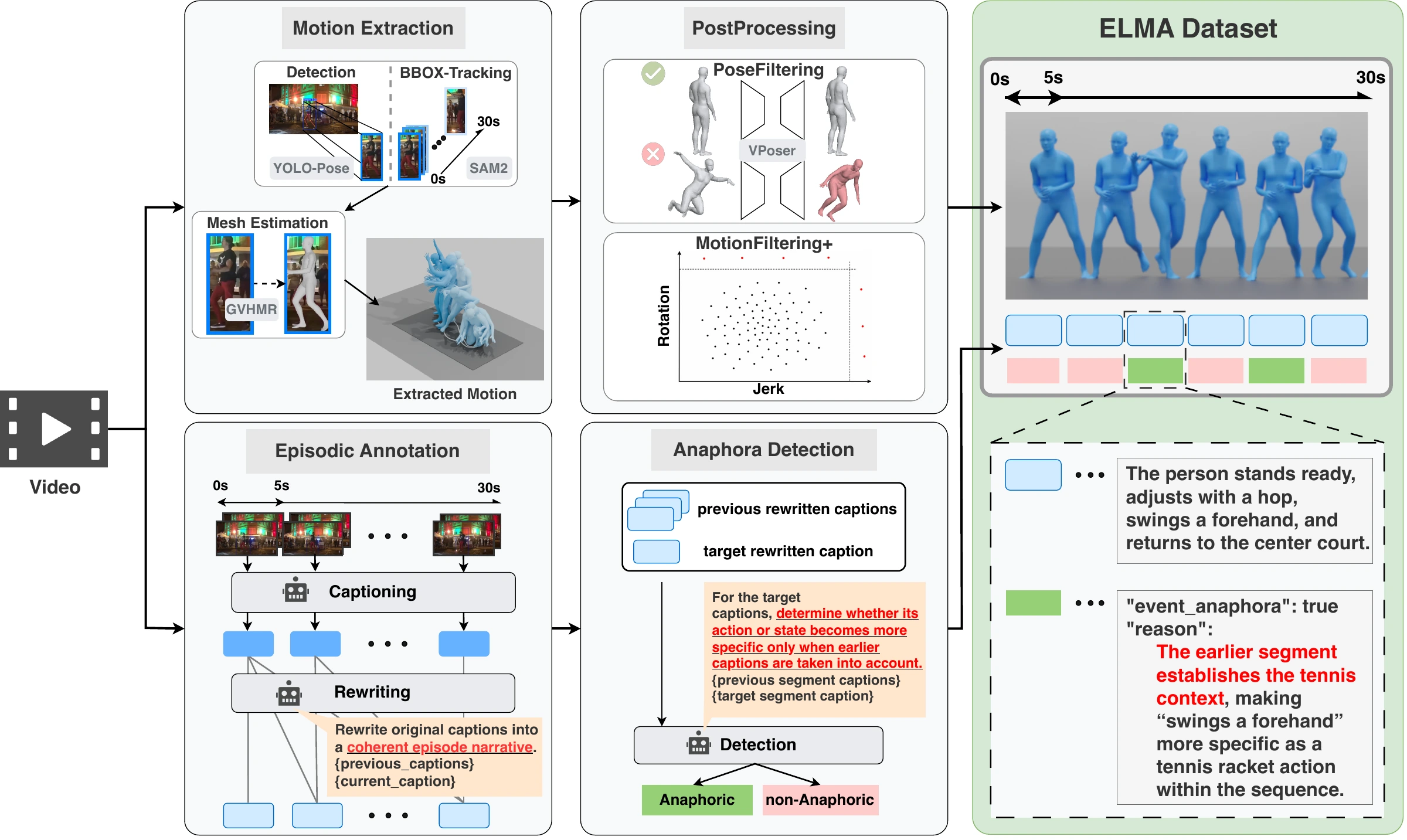
Our fully automated pipeline consists of two main streams: motion extraction and quality control, and episodic text annotation with anaphora detection. In the motion stream, we track people in in-the-wild videos, select continuous 30-second clips with full-body visibility, and reconstruct 3D motions using GVHMR. We then filter out implausible poses and abnormal motion dynamics. In the annotation stream, we divide each clip into six 5-second segments and generate captions using Gemini 2.5 Pro. Each caption is then rewritten with preceding captions as context to preserve episodic continuity. Finally, GPT-4o identifies segments whose motion descriptions become more specific with earlier context and labels their dependency source segments.
ELMABench
ELMABench evaluates long-term motion generation from multi-segment instructions, focusing on cases where earlier descriptions provide useful context for interpreting later ones. Each example pairs six 5-second instructions with a continuous 30-second reference motion. We compare independent (T2M) and anaphoric (A2M) instruction settings using DoubleTake, FlowMDM, and UniMotion. Evaluation is restricted to anaphoric target segments, assessing motion quality and text alignment where cross-segment context matters.
| Method | Train → Inference | FID ↓ | R-P@3 ↑ | Diversity → | Matching Score ↓ |
|---|---|---|---|---|---|
| GT | – | 0.21 ±0.03 | 0.480 ±0.009 | 7.31 ±0.16 | 4.53 ±0.07 |
| DoubleTake | T2M → T2M | 4.64 ±0.20 | 0.189 ±0.007 | 12.38 ±0.02 | 8.07 ±0.09 |
| DoubleTake | T2M → A2M | 5.16 ±0.23 | 0.184 ±0.006 | 12.18 ±0.03 | 7.91 ±0.12 |
| DoubleTake | A2M → A2M | 3.95 ±0.18 | 0.192 ±0.007 | 12.34 ±0.04 | 8.10 ±0.11 |
| FlowMDM | T2M → T2M | 1.63 ±0.08 | 0.441 ±0.008 | 5.21 ±0.03 | 7.72 ±0.09 |
| FlowMDM | T2M → A2M | 1.94 ±0.09 | 0.421 ±0.006 | 5.32 ±0.03 | 7.60 ±0.10 |
| FlowMDM | A2M → A2M | 1.53 ±0.06 | 0.466 ±0.008 | 4.92 ±0.03 | 8.12 ±0.11 |
| UniMotion | T2M → T2M | 18.24 ±0.20 | 0.197 ±0.004 | 6.47 ±0.06 | 10.10 ±0.02 |
| UniMotion | T2M → A2M | 18.35 ±0.20 | 0.192 ±0.005 | 6.45 ±0.08 | 10.03 ±0.03 |
| UniMotion | A2M → A2M | 19.01 ±0.15 | 0.185 ±0.003 | 6.52 ±0.06 | 10.11 ±0.02 |
BibTeX
@inproceedings{kato2026elma,
  title     = {{ELMA}: Benchmarking Anaphoric Compositions for Long-Term Text-to-Motion Generation},
  author    = {Kato, Shun and Yang, Dixin and Amaya, Kotaro and Wada, Yuiga and Fukuda, Kazumi and
               Shibuya, Takashi and Mitsufuji, Yuki and Isogawa, Mariko},
  booktitle = {Advances in Neural Information Processing Systems (NeurIPS), Evaluations and Datasets Track},
  year      = {2026},
  eprint    = {2610.13549},
  archivePrefix = {arXiv},
  primaryClass  = {cs.CV}
}